
PRP Treatment in London: Cost, Results, Reviews & Procedure (Complete Guide)
If you are noticing thinning hair, dull skin, or fine lines that seem to appear overnight, you are not alone – and you are probably already searching for treatments that deliver real results without the risk and downtime of treatment.
That is exactly why PRP treatment in London has become one of the most in-demand regenerative procedures in the UK in 2026.
PRP, or Platelet Rich Plasma, uses your body’s own growth factors to stimulate collagen production, repair damaged skin, and revive thinning hair.
It is natural, minimally invasive, and backed by a growing body of clinical evidence.
But with over 60 clinics now offering PRP across London, the difference in quality, pricing, and outcomes can be enormous.
This guide covers everything you need to know before booking – how PRP works, what it costs, what results to expect, how long it takes, and what to look for in a clinic you can trust.
What Is PRP Treatment and How Does It Work?
PRP stands for Platelet Rich Plasma. It is a regenerative therapy that uses a concentrated portion of your own blood – rich in platelets and growth factors – to stimulate healing, collagen production, and tissue repair in the skin or scalp.
The science behind it is straightforward.
Platelets are a natural component of your blood that plays a key role in wound healing and tissue regeneration.
They contain powerful growth factors including PDGF (Platelet-Derived Growth Factor), VEGF (Vascular Endothelial Growth Factor), and TGF-β (Transforming Growth Factor Beta).
When these platelets are isolated, concentrated to levels three to five times higher than normal blood, and then reintroduced into targeted areas, they trigger a cascade of cellular repair – increasing collagen synthesis, promoting new blood vessel formation, and activating dormant cells.
PRP treatment in London is now used for two primary purposes: skin rejuvenation (face, neck, under-eyes, hands) and hair restoration (scalp thinning and early-stage hair loss).
How the PRP Procedure Works: Step by Step
One of the reasons PRP has gained popularity is that the procedure itself is quick, relatively comfortable, and requires no significant downtime. Here is what a typical session looks like:
Step 1 – Consultation and assessment.
Before any treatment, a thorough consultation is essential. Your practitioner should review your medical history, examine the treatment area, discuss your goals, and confirm that you are a suitable candidate.
At Wellbeing Aesthetic, every PRP journey begins with a personalized consultation with our medically trained team to ensure we fully understand your skin, health, and expectations before we proceed.
Step 2 – Blood draw.
A small sample of blood is taken from your arm – usually around 10 to 30 ml depending on the treatment area. This is the same process as a routine blood test and takes under five minutes.
Step 3 – Centrifugation.
The blood sample is placed in a medical-grade centrifuge and spun at a carefully calibrated speed. This separates the blood into layers: red blood cells settle at the bottom, while the platelet-rich plasma rises to the top. The concentrated PRP is then extracted for treatment.
Step 4 – Preparation and numbing.
The treatment area is cleaned, and a topical numbing cream is applied to minimise discomfort. Some clinics also use local anaesthetic for enhanced comfort, particularly for scalp treatments.
Step 5 – PRP delivery.
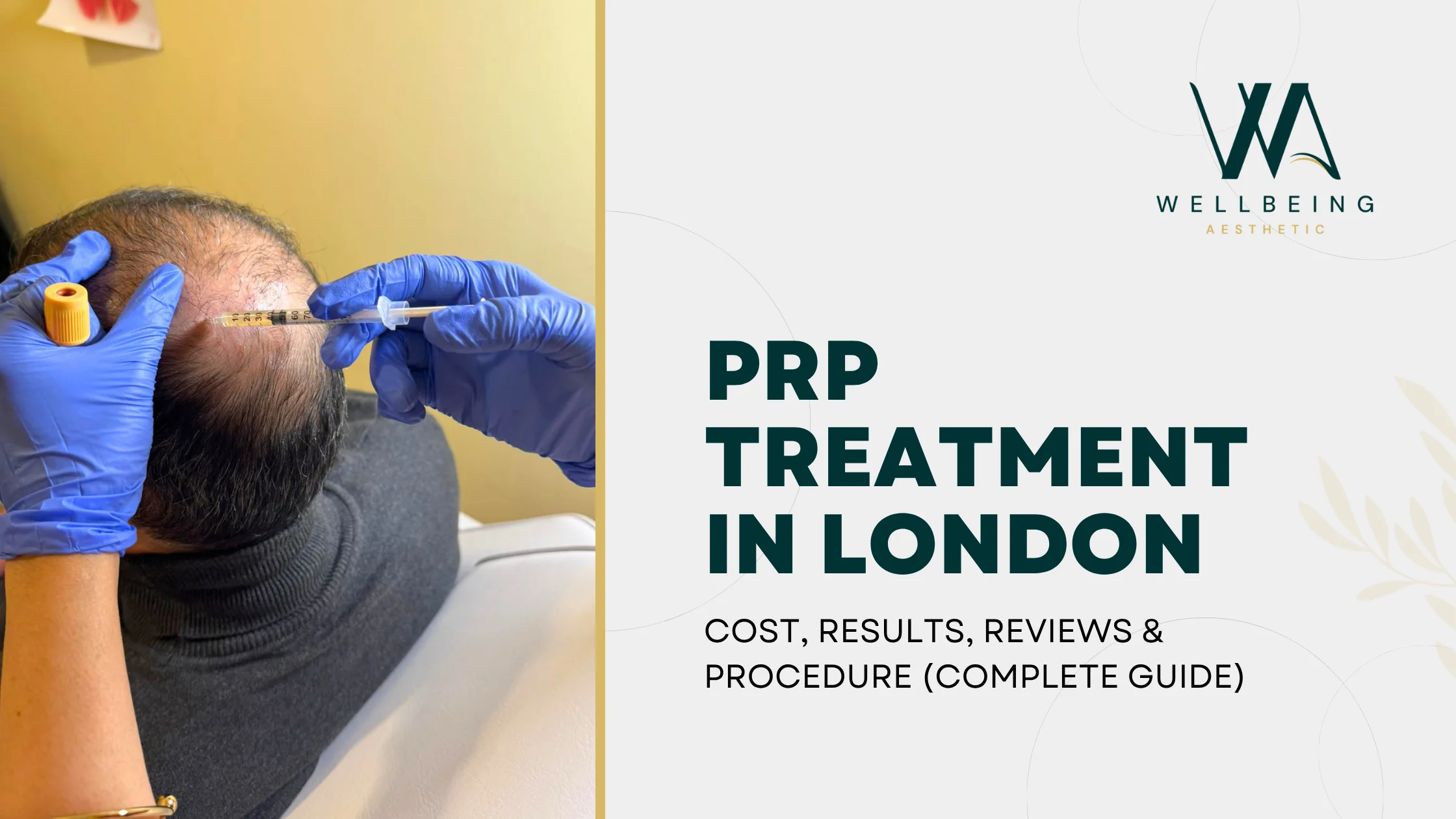
The concentrated PRP is reintroduced into the target area. For facial rejuvenation, this is typically done through precise micro-injections into the dermis, sometimes combined with medical grade microneedling for deeper, more even absorption. For hair restoration, PRP is injected directly into the scalp in a grid pattern across thinning areas.
Step 6 – Aftercare.
There is little to no downtime. You may experience mild redness, slight swelling, or minor sensitivity at the treatment site, which usually resolves within 24 to 48 hours. Most patients return to normal activities on the same day.
The entire procedure – from blood draw to completion – typically takes 45 to 60 minutes.
PRP for Skin Rejuvenation: What to Expect
PRP facial treatment – sometimes known as the “vampire facial” – has become one of the most sought-after skin rejuvenation options in London. Unlike dermal fillers, which add volume from an external source, PRP works from within by stimulating your own skin repair mechanisms.
When PRP is injected into or microneedle across the skin, the concentrated growth factors signal your fibroblasts (the cells responsible for producing collagen and elastin) to ramp up production. Over the weeks following treatment, this leads to visible improvements in skin texture, tone, elasticity, and overall radiance.
What PRP facial treatment can address:
- Fine lines and early wrinkles, particularly around the eyes and mouth
- Uneven skin texture and enlarged pores
- Dull, tired-looking skin that lacks radiance
- Under-eye hollowing, dark circles, and crepey skin
- Acne scarring and post-inflammatory hyperpigmentation
- Skin laxity on the neck, décolletage, and hands
Typical results timeline for facial PRP:
- Days 1-3: Mild redness or swelling, similar to a light sunburn. This settles quickly.
- Weeks 2-4: Early improvements in skin brightness and texture become noticeable. Skin starts to look fresher and more hydrated.
- Weeks 6-12: Collagen remodeling becomes established. Skin feels firmer, smoother, and more elastic. Fine lines begin to soften.
- Months 3-6: Full results develop. Many patients report the best improvements between the third and sixth months as cumulative collagen production reaches its peak.
Most practitioners recommend a course of three sessions spaced four to six weeks apart for optimal results, followed by maintenance treatments every six to twelve months to sustain improvements.
It is worth noting that PRP is a skin-quality treatment, not a volumiser. It will not replace lost facial volume or create dramatic structural changes.
For patients seeking volume restoration, PRP can be combined with dermal fillers as part of a tailored treatment plan – something your practitioner should discuss during your consultation.
PRP for Hair Restoration: Does It Actually Work?
This is the question most people searching for PRP hair treatment in London want answered directly – and the honest answer is yes, for the right candidates; PRP can produce meaningful, measurable results.
Clinical evidence supports PRP as an effective treatment for early to moderate hair thinning. A widely cited meta-analysis published in the Journal of Cosmetic Dermatology – which analyzed data from randomized controlled trials – found that PRP treatment produced a statistically significant increase in hair density compared to placebo groups.
Multiple clinical studies have consistently reported density improvements of approximately 30 to 40 additional hairs per square centimeter in responding patients.
Who responds best to PRP hair treatment:
- Men and women with early to moderate pattern hair loss (Norwood stages 2-4 for men, Ludwig stages 1-2 for women)
- Hair thinning that has developed within the past five years
- Patients who still have active hair follicles in the treatment area – PRP revives dormant follicles but cannot resurrect completely dead ones
- Non-smokers or those willing to stop smoking during the treatment course
- Patients not currently on blood-thinning medication
Typical results timeline for hair PRP:
- Weeks 2-4: Reduced hair shedding is often the first change patients notice
- Months 2-3: Fine “baby hairs” begin appearing in treated areas
- Months 4-6: Visible increase in hair density, thickness, and coverage
- Months 6-12: Maximum results achieved, particularly when combined with maintenance treatments
A standard initial treatment protocol involves three to four sessions spaced four to six weeks apart, followed by maintenance sessions every three to six months.
Patients who complete the full initial course consistently achieve better outcomes than those who stop after one or two sessions.
Important to acknowledge: PRP is not a miracle cure for advanced baldness. If the treatment area has been completely balding for many years, the follicles may be permanently miniaturized or inactive, and PRP is unlikely to restore growth in those zones.
This is why a proper clinical assessment before treatment is essential – a responsible clinic will be upfront about whether PRP is genuinely appropriate for your specific pattern of hair loss.
How Much Does PRP Treatment Cost in London?
Cost is one of the most common concerns – and one of the most confusing, because pricing across London varies enormously. Here is a transparent breakdown to help you understand what you are paying for.
Typical PRP treatment cost in London (2026):
| Tier | Price Per Session | What You Typically Get |
|---|---|---|
| Budget clinics | £200-£300 | Basic centrifuge equipment, often administered by non-medical staff, limited consultation |
| Mid-range clinics | £300-£550 | Qualified practitioners, better equipment, personalised consultation and aftercare |
| Premium clinics | £550-£850+ | GMC-registered doctors, advanced dual-spin centrifuge systems, comprehensive protocols |
What affects PRP pricing:
- Centrifuge quality and platelet concentration. This matters more than most patients realise. A basic single-spin centrifuge may only achieve 1.5-2x platelet concentration. Advanced medical-grade systems achieve 5-8x concentration – and higher concentration correlates directly with better clinical outcomes. The difference between a £200 session and a £500 session often comes down to this.
- Practitioner qualifications. Sessions administered by a medically trained doctor cost more than those performed by a beauty therapist, but the precision of injection technique and depth of clinical assessment are significantly higher.
- Blood volume is processed. Budget treatments may use just 10-15 ml of blood. Optimal protocols use 20-30 ml or more, which produces a greater volume of concentrated growth factors.
- Included services. Some clinics bundle consultation, aftercare, and progress photography into the session price. Others charge separately for each.
PRP vs Other Treatments: How Does It Compare?
| Treatment | How It Works | PRP Advantage | Combine? |
|---|---|---|---|
| Dermal Fillers (Skin) | Adds volume externally using hyaluronic acid | PRP builds collagen from within, improving skin quality not just volume | Yes |
| Hair Transplant (Hair) | Surgically moves follicles to balding areas | Non-surgical, no downtime, lower cost; ideal for early to moderate thinning | Yes |
| Microneedling Alone (Skin) | Micro-injuries trigger collagen production | PRP penetrates deeper through micro-channels, amplifying results | Yes |
| Minoxidil / Finasteride (Hair) | Medication that slows loss and stimulates regrowth | PRP adds a biological growth-factor pathway medications cannot provide | Yes |
PRP vs Dermal Fillers (for skin)
Dermal fillers add volume externally using hyaluronic acid or similar substances. PRP works from within by stimulating your own collagen production. Fillers deliver immediate, visible results but are temporary (typically lasting 6-18 months). PRP results develop gradually over weeks but address the underlying quality of your skin rather than simply adding volume. Many patients find the best outcomes come from combining both treatments.
PRP vs Hair Transplant (for hair)
Hair transplants surgically relocate hair follicles from a donor area to balding zones. This is a permanent solution for advanced hair loss but involves significant cost (£4,000-£15,000), 1-2 weeks of downtime, and potential scarring. PRP is non-surgical, has no downtime, and costs considerably less. It works best for early to moderate thinning – and many surgeons now recommend PRP alongside hair transplants to improve graft survival and enhance outcomes.
PRP vs Microneedling alone (for skin)
Microneedling on its own stimulates collagen by creating controlled micro-injuries in the skin. When combined with PRP, the micro-channels created by the needles allow the concentrated growth factors to penetrate deeper and more evenly, amplifying results. Research suggests the combination produces synergistic effects that exceed either treatment individually.
PRP vs Minoxidil and Finasteride (for hair)
These are topical and oral medications used to slow hair loss and stimulate regrowth. They work through different mechanisms than PRP, and many clinics recommend combining PRP with one or both medications for a comprehensive multi-pathway approach to hair restoration.
Side Effects and Safety: What Are the Risks?
PRP is considered one of the safest aesthetic treatments available. Because it uses your own blood, the risk of allergic reaction, infection from foreign substances, or rejection is extremely low.
Common side effects (temporary and mild):
- Mild redness or swelling at the treatment site – resolves within 24-48 hours
- Minor tenderness or sensitivity – resolves within 1-2 days
- Pinpoint bruising at injection sites – resolves within 3-7 days
- Occasional mild headache (for scalp treatments) – resolves with paracetamol
Rare side effects:
- Infection – extremely rare when proper sterile technique is followed
- Prolonged bruising or swelling – uncommon and self-resolving
- Temporary numbness at injection sites
Who should avoid PRP treatment:
- People with blood disorders or platelet dysfunction
- Patients currently on blood-thinning medications (e.g., warfarin, aspirin)
- Active skin infections or conditions in the treatment area
- Those undergoing active chemotherapy or radiotherapy
- Pregnant or breastfeeding women
- Patients with a history of keloid scarring (for microneedling-combined PRP)
A thorough pre-treatment consultation should identify any contraindications before you proceed. If a clinic does not conduct a proper medical assessment before treating you, that is a significant red flag.
How to Choose the Right PRP Clinic in London
With many clinics now offering PRP across London, choosing the right one is important. The same treatment name can mean very different things at different clinics. Here is what to look for:
1. Medically trained practitioners. PRP involves drawing blood, processing it, and performing precise injections. This should be carried out by – or under the direct supervision of – a qualified medical professional. Look for GMC-registered doctors, medically trained nurses with aesthetic specialisations, or practitioners with verifiable medical qualifications.
2. Quality of equipment. Ask what centrifuge system the clinic uses. Advanced dual-spin or automated systems produce significantly higher platelet concentrations than basic single-spin centrifuges, and this directly affects treatment outcomes.
3. Transparent consultation process. A reputable clinic will conduct a thorough consultation before treatment – assessing your suitability, explaining the procedure, setting realistic expectations, and discussing costs openly. Be cautious of clinics that push you to book immediately without proper assessment.
4. Honest expectations. No responsible clinic will promise guaranteed results. PRP works well for many patients, but outcomes vary based on individual biology, the specific condition being treated, and how early you intervene. A good practitioner will tell you whether PRP is genuinely likely to help your situation.
5. Reviews and patient experiences. Look for verified reviews across platforms like Google, Trustpilot, and Treatwell. Pay attention to reviews that mention the consultation process, practitioner expertise, and follow-up care – not just the results.
6. Aftercare and follow-up. Effective PRP treatment does not end when you leave the clinic. Your provider should offer clear aftercare guidance and follow-up appointments to track progress and adjust your treatment plan as needed.
Why Patients Choose Wellbeing Aesthetic for PRP Treatment
At Wellbeing Aesthetic, PRP is one of our core treatments – and it reflects everything our clinic stands for: medically guided care, natural-looking results, and a patient-first approach.
Our clinic is led by Dr. Huma Saeed, a medically trained professional with extensive NHS experience who specialises in PRP and regenerative treatments.
Every treatment at our clinic begins with a thorough consultation, because we believe understanding your skin, your health, and your goals is the essential first step to delivering outcomes you can genuinely feel confident about.
We combine medical expertise with advanced technology and personalised treatment planning. Our PRP protocols are tailored to your individual needs – whether you are looking to rejuvenate your skin, restore thinning hair, or address under-eye concerns.
What our patients consistently highlight is the care, transparency, and clinical professionalism they experience:
- From consultation to treatment, everything was professional and reassuring. My skin looks fresher and healthier, and the results are so natural.
- The doctor took time to explain the treatment and the results were better than expected. I felt safe and well looked after.
If you are considering PRP treatment in London and want to start with a proper medical assessment rather than a hard sell, we would love to help.
Conclusion
PRP treatment in London is one of the safest, most natural ways to rejuvenate your skin or restore thinning hair – no surgery, no synthetic substances, and minimal downtime. The key to getting real results lies in choosing a medically guided clinic that uses quality equipment, conducts a proper assessment, and sets honest expectations from the start.
At Wellbeing Aesthetic, we do exactly that. Every PRP treatment is led by our medically trained team, tailored to your individual goals, and delivered with the clinical care and transparency you deserve.
Book your consultation today and let us help you decide whether PRP is the right next step for your skin or hair.
Frequently Asked Questions About PRP Treatment
Most patients describe PRP as mildly uncomfortable rather than painful. Topical numbing cream is applied before treatment, and the injections feel like small pinches. Most patients rate discomfort at around 3 out of 10. Local anaesthetic is available for patients who prefer additional numbing, particularly for scalp treatments.
PRP results are not permanent and require maintenance. After an initial course of three sessions, most patients maintain results with one to two sessions every six to twelve months. Without maintenance, the effects gradually diminish over 12 to 18 months as the natural ageing process continues.
Yes. PRP works particularly well alongside microneedling, dermal fillers, and LED light therapy for skin rejuvenation. For hair restoration, combining PRP with topical treatments such as minoxidil has been shown to enhance outcomes compared to either treatment alone.
One of the advantages of PRP is that it is suitable for all skin types and tones because it uses your own blood - there is no risk of pigmentation changes or adverse reactions associated with skin colour, which can be a concern with some laser treatments.
Most patients require an initial course of three sessions, spaced four to six weeks apart. Results become progressively more visible after each session. Following the initial course, maintenance sessions every six to twelve months help sustain and build improvements.
Downtime is minimal. You may have mild redness or slight swelling for 24 to 48 hours, but most patients return to their normal routine the same day. We recommend avoiding intense exercise for 48 hours and not washing your hair (for scalp treatments) for at least 24 hours.
PRP is increasingly used for under-eye rejuvenation. The growth factors stimulate collagen production and improve blood supply in the delicate periorbital area, which can reduce the appearance of dark circles, hollowing, and crepey skin under the eyes.
No. PRP for aesthetic purposes (skin rejuvenation and hair restoration) is classified as an elective cosmetic treatment and is not available through the NHS. It is a private, out-of-pocket investment.
Book your consultation today!
Fill out the form below and we’ll be in touch shortly.