
Polynucleotides Under Eyes: Benefits, Results, Side Effects and How Long They Last
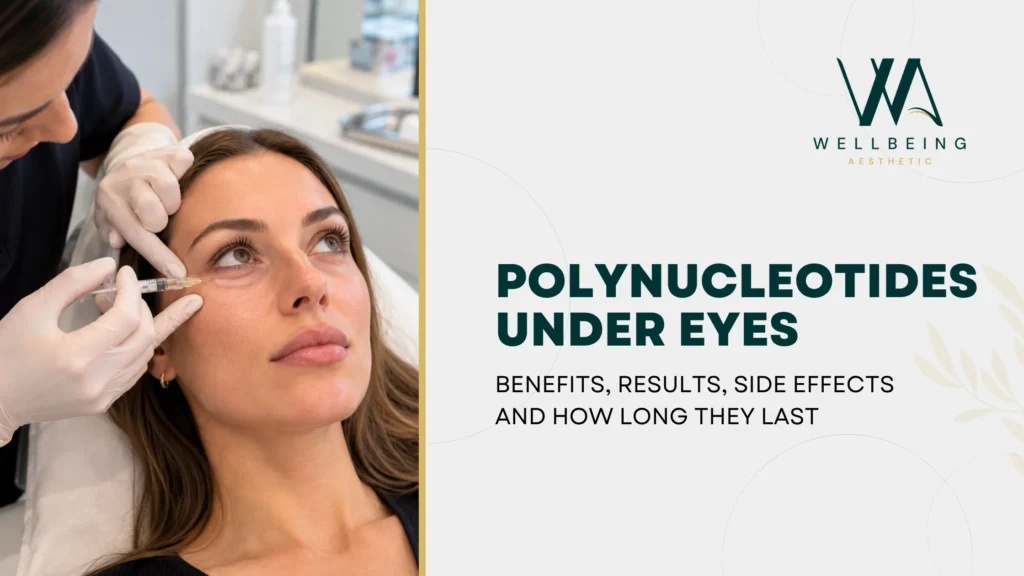
Polynucleotides Under Eyes: Benefits, Results, Side Effects and How Long They Last Under-eye polynucleotides are injectable treatments used to improve skin quality rather than add volume. They may help with thin, crepey or dehydrated-looking skin and fine lines, while true under-eye hollows usually require a different approach. Treatment normally involves a short course rather than one appointment. Concealer can settle into fine lines when under-eye skin is dry, thin or crepey, although several factors can contribute to how the area looks. It is one of the reasons polynucleotides have become part of Wellbeing Aesthetic’s regenerative treatment range in Croydon, alongside dermal fillers and Profhilo. Unlike a filler, polynucleotides do not add volume under the eyes. They work at a cellular level to support the skin’s own repair processes, which is why they are often considered for thin, crepey or tired-looking under-eye skin rather than visible hollows. This guide covers what polynucleotides actually are, how they work under the eyes, what results and side effects to realistically expect, how long results last, and who should avoid the treatment altogether, including an important point about fish allergy. None of this replaces a proper consultation. Skin type, medical history and your goals all affect whether polynucleotides are the right starting point for you, which is why a treatment plan should always begin with an assessment rather than a menu. Key Takeaways Repairs rather than fills. Polynucleotides work at a cellular level to support skin repair and regeneration rather than adding volume the way a filler does. Built around a short course. Most practitioners recommend three to four sessions spaced two to four weeks apart rather than a single appointment. Results build progressively. Improvements in skin texture, hydration and fine lines typically develop over the weeks following treatment, not immediately. Fish allergy is an important contraindication. Most polynucleotide products are derived from purified salmon DNA, so a known fish or seafood allergy generally rules out this treatment. Not a fix for hollowing caused by volume loss. Under-eye hollows from lost structure are usually better addressed with a dermal filler rather than polynucleotides. Side effects are usually mild. Temporary swelling, bruising or tenderness at injection points are the most commonly reported reactions. Results can last several months. Benefits build across a course and are generally reported to last around six months, with maintenance reviewed individually. Pricing reflects the clinic and course length. UK under-eye polynucleotide sessions generally fall between £250 and £500 each. What Are Polynucleotides? Polynucleotides are an injectable treatment made from purified DNA fragments, designed to support the skin’s own repair and regeneration processes rather than add shape or volume. They are often grouped with other bio-stimulatory treatments because they work with the skin’s biology instead of sitting beneath it like a filler. Most polynucleotide products used across the industry are derived from purified salmon DNA, which is why a known fish or seafood allergy is treated as an important contraindication and something your practitioner will ask about at consultation. You can see examples of the results this treatment produces in the Wellbeing Aesthetic gallery, alongside the clinic’s other regenerative treatments. How Do Polynucleotides Work Under the Eyes? The skin under the eyes is thinner and more delicate than almost anywhere else on the face, which is why it is often the first area to show fine lines, crepiness or a tired appearance. A practitioner delivers small, precise deposits of polynucleotides just beneath the skin surface in this area. Once injected, the fragments support the activity of fibroblasts, the cells responsible for producing collagen and elastin, while also helping the tissue hold moisture. Over several weeks, many patients notice firmer, better hydrated skin with a smoother texture around the eyes. What Are the Benefits of Polynucleotides Under the Eyes? Improved skin texture and firmness as collagen and elastin production is supported Better hydration in an area that is often thin and prone to dryness A reduction in the appearance of fine, superficial lines under the eyes Suitability for patients who do not want, or do not need, added volume in this area A regenerative option that can be considered alongside or instead of filler, depending on the underlying cause of your concern These are gradual, quality-focused outcomes rather than a dramatic change overnight. Where skin repair and texture are the main goal rather than volume, some patients also ask about PRP treatment, which works on a similar regenerative principle using the patient’s own plasma. Polynucleotides vs Dermal Filler vs Profhilo for Under Eyes These three treatments are sometimes confused because they can all be used around the eyes, yet they solve different problems. The table below sets out how they compare. Treatment Main Purpose Typical Results Last Best For Polynucleotides Cellular repair and skin regeneration Around 6 months Thin, crepey or tired-looking under-eye skin without hollowing Dermal Filler Restoring lost volume in the tear trough 9 to 18 months Visible hollows or shadowing caused by lost volume Profhilo Bio-remodelling and collagen stimulation 6 to 12 months General skin laxity across the face, neck or hands If your main concern under the eyes is a visible hollow rather than skin quality, our lip filler swelling stages guide gives a sense of what to expect from hyaluronic acid filler healing, since the same product category is often used in the tear trough. EXPLORE YOUR OPTIONS If skin quality, rather than lost volume, is your main concern under the eyes, it’s worth exploring the full range of treatments available at Wellbeing Aesthetic before deciding what to book. Explore Treatments → What Happens During a Polynucleotide Treatment for Under Eyes? Consultation and assessment. Your practitioner reviews your skin, medical history and goals, and screens specifically for fish allergy before confirming you are suitable. Cleansing and preparation. The area is cleaned thoroughly, and numbing cream can be applied if you find injections uncomfortable. Micro-injections. Small, precise deposits are placed just beneath the skin around the orbital area using a fine needle. Aftercare guidance. You will be talked
Profhilo Treatment in London: Benefits, Cost, Results and Aftercare
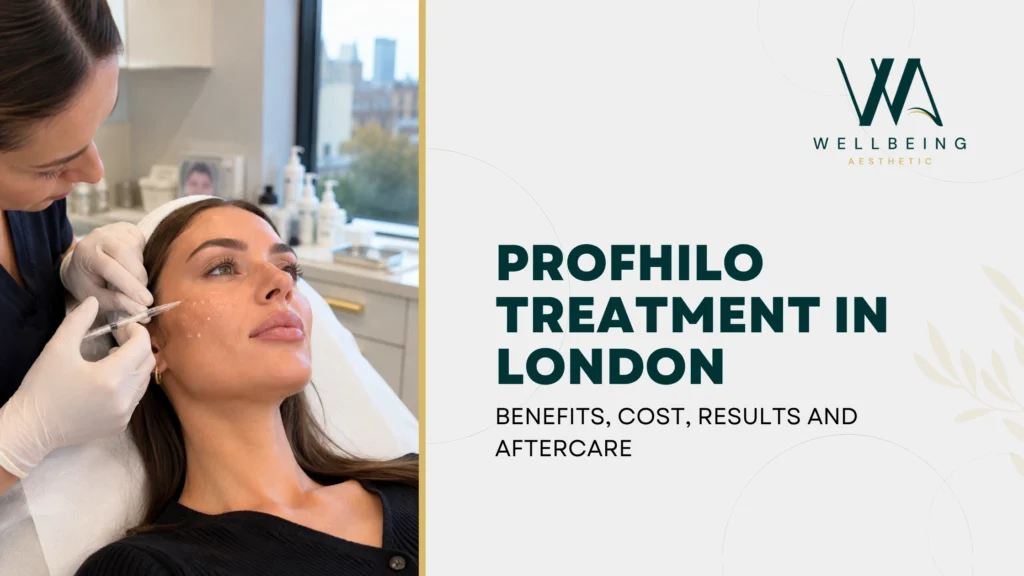
Profhilo Treatment in London: Benefits, Cost, Results and Aftercare Crepey, thinning skin around the jawline or neck rarely responds to a heavier moisturiser or a stronger serum. It is one of the reasons Profhilo has become one of the most requested treatments at Wellbeing Aesthetic’s Croydon clinic, alongside anti-wrinkle injections and dermal fillers. Unlike a filler, Profhilo does not add volume or reshape a feature. It works beneath the skin to encourage your own collagen and elastin production, gradually improving firmness, hydration and overall skin quality rather than filling a specific line or hollow. If you are in Croydon or the wider South London area and searching for what a Profhilo treatment actually involves, this guide covers how it works, what it costs, how long results last, and what a sensible aftercare routine looks like. None of this replaces a proper consultation. Skin type, medical history and your goals all affect whether Profhilo is the right starting point, which is why a treatment plan should always begin with an assessment rather than a menu. Key Takeaways Bio-remodelling, not volumising. Profhilo stimulates the skin’s own collagen and elastin rather than adding volume the way a dermal filler does. Built around two sessions. A standard course is two treatments spaced around four weeks apart, rather than a single appointment. Results build gradually. Most people notice firmer, more hydrated skin developing over several weeks as collagen and elastin production increases. Results generally last six to twelve months. Maintenance is usually considered from six months onward and reviewed individually rather than fixed to a single schedule. It is not the same as anti-wrinkle injections. Profhilo does not relax muscles, so it will not soften lines caused by repeated expression. Downtime is minimal for most people. Small bumps at injection points typically settle within a day, with occasional mild bruising. Pricing reflects the clinic and product, not a fixed figure. UK Profhilo sessions generally fall between £250 and £450 each, with a two-session course often costing £500 to £900. Not everyone is a suitable candidate. Pregnancy, breastfeeding, active skin infections, and certain allergies typically mean postponing treatment until a practitioner confirms it is appropriate. What Is Profhilo? Profhilo is an injectable treatment containing a high concentration of hyaluronic acid, developed to improve skin quality rather than add shape or volume. It is often described as a bio-remodelling treatment because it works with the skin’s own repair processes rather than sitting under the surface as a filler would. A practitioner injects the product at a small number of points, typically five per side of the face, where it spreads through the tissue and stimulates the production of collagen and elastin. Because the formulation is designed to disperse rather than hold a shape, Profhilo does not change facial contour. How Does Profhilo Work? Profhilo contains 64 mg of hyaluronic acid in a 2 ml syringe, combining high and low molecular weight hyaluronic acid used in aesthetic medicine, combined in a way that allows it to spread slowly through the skin after injection. As it disperses, it draws in moisture and triggers fibroblasts, the cells responsible for producing new collagen and elastin. This process, often called bio-remodelling, unfolds gradually rather than immediately. Over several weeks, many patients notice firmer, more hydrated skin with a smoother texture, particularly in areas prone to laxity such as the lower face, neck and hands. What Are the Benefits of Profhilo Treatment? Improved skin firmness and elasticity as collagen and elastin production increases. Improved skin hydration through injectable hyaluronic acid, thanks to the high hyaluronic acid concentration. A smoother, more even texture, often described as a healthier rather than a dramatically different look. Suitability for areas that do not need volume, such as the neck, jawline, and backs of the hands. Subtle skin-quality improvement without adding the structural volume associated with dermal fillers. These are gradual, quality-focused outcomes rather than a dramatic transformation. If you would like to see how Profhilo compares with the clinic’s other treatments, the Wellbeing Aesthetic gallery shows results across the range of services offered. Profhilo vs Dermal Fillers vs Skin Boosters: What Is the Difference? These three injectable treatments are frequently confused because they can all use hyaluronic acid, yet they solve different problems. The table below sets out how they compare. Treatment Main Purpose Typical Results Last Best For Profhilo Bio-remodelling and collagen stimulation 6 to 12 months Overall skin laxity and quality across the face, neck or hands Dermal Fillers Restoring lost volume and contour 9 to 18 months Hollowed cheeks, thinning lips, or lost facial structure Skin Boosters Deep hydration and improved texture 4 to 6 months Dull, dehydrated or tired looking skin without volume loss COMPARE YOUR OPTIONS If skin laxity, rather than lost volume, is your main concern, it’s worth exploring the full range of treatments available at Wellbeing Aesthetic before deciding what to book. Explore Treatments → Who Is Profhilo Suitable For? Profhilo tends to suit people noticing early skin laxity, crepiness or dullness rather than deep, static wrinkles or significant volume loss. Profhilo may suit adults experiencing mild skin laxity, crepiness, dehydration or declining skin quality who want improvement without adding structural volume. If your main concern is lines caused by repeated expression, such as frown lines or crow’s feet, our anti-wrinkle treatment guide explains that option in more depth, since Profhilo is not designed to relax muscle movement. What Happens During a Profhilo Treatment in London? Consultation and skin assessment. Your practitioner reviews your skin, medical history, and goals before confirming Profhilo is appropriate for you. Cleansing and preparation. The treatment area is cleaned thoroughly, and numbing cream can be applied if you find injections uncomfortable. Injections at key points. A small number of injections, typically five per side, deliver the product beneath the skin at carefully chosen points. Aftercare guidance. You will be talked through what to expect over the following days and given advice on protecting your results. A second session around four weeks later. The standard
Skin Boosters vs Dermal Fillers: What Is the Difference?
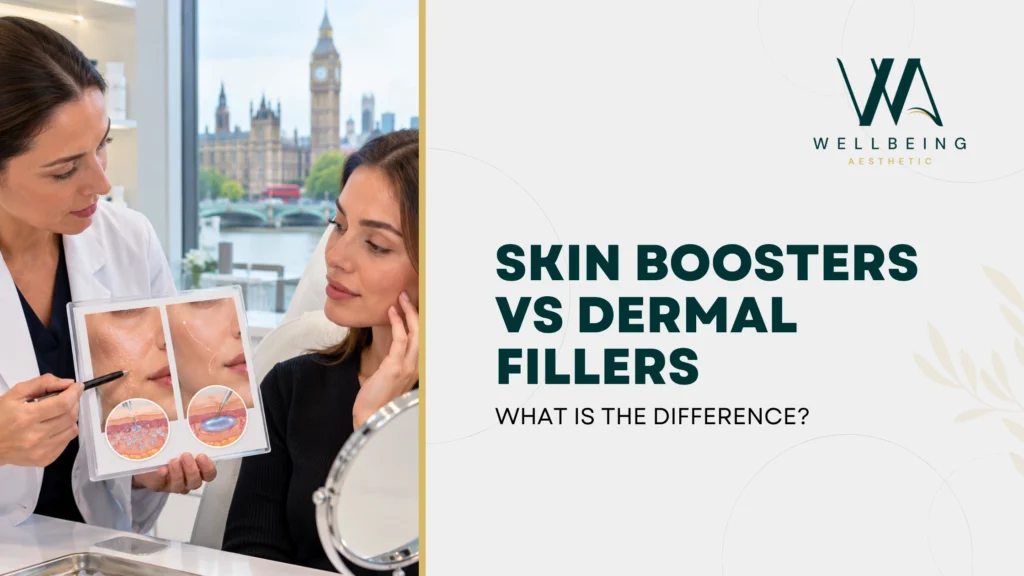
Skin Boosters vs Dermal Fillers: What Is the Difference? Standing in front of a treatment menu with “skin booster” and “dermal filler” listed one above the other is a common moment of confusion. Both use hyaluronic acid, both are delivered by injection, and both promise better looking skin, so it is easy to assume they do roughly the same job. They do not. One treatment rebuilds hydration and texture from within the skin. The other restores volume and structure that has been lost, or that was never quite there to begin with. Choosing the wrong one for your concern is one of the most common reasons people feel disappointed with a treatment, not because it failed, but because it was never designed to solve that particular problem. This guide sets out how skin boosters and dermal fillers differ, what each does beneath the skin, how their costs and results compare, and whether the two can be combined. You can see both sit alongside the rest of the aesthetic treatments available at Wellbeing Aesthetic’s Croydon clinic, a useful starting point before your consultation. As with any injectable treatment, none of this replaces a proper assessment. Skin type, medical history and your specific goals all affect which treatment, or combination of treatments, makes sense for you, which is why a consultation with a qualified practitioner should always come before booking either one. Key Takeaways Different jobs, same ingredient. Both treatments often use hyaluronic acid, but skin boosters hydrate the skin’s texture while dermal fillers restore lost volume and shape. Skin boosters spread, fillers hold their position. Skin boosters use a thinner, more fluid hyaluronic acid that disperses evenly, while dermal fillers use thicker, often cross linked gels designed to hold their structure. Longevity differs considerably. Skin booster results generally last around four to six months, while dermal filler results commonly last nine to eighteen months depending on the product and area treated. They are not interchangeable. A skin booster will not lift a hollow cheek, and a dermal filler is not designed to treat overall dullness or dehydration. Combining them is sometimes appropriate. Some patients benefit from a course of skin boosters alongside filler in a different area, but only when a practitioner confirms there is a genuine clinical reason for each treatment. Cost reflects the treatment, not just the product. UK skin booster sessions typically start lower than a full syringe of dermal filler, though prices vary by clinic, product and treatment area. Downtime is usually milder with skin boosters. Fillers can cause more noticeable swelling or bruising, particularly around the lips or under the eyes, while skin boosters tend to settle within a day or two. The right choice depends on your concern. Dullness and dehydration point toward a skin booster, while volume loss or contour change points toward a dermal filler, and a consultation clarifies which applies to you. What Is the Main Difference Between Skin Boosters and Dermal Fillers? The main difference comes down to purpose. Skin boosters use a thin hyaluronic acid solution, injected in small amounts across the skin, to improve hydration, texture and radiance. Dermal fillers use a thicker hyaluronic acid gel, injected at specific points, to add volume, reshape a feature or restore lost structure. This one distinction, hydration versus volume, shapes almost everything else in this guide, from the injection technique used to how long the results last and what each treatment reasonably costs. What Are Dermal Fillers and How Do They Work? Dermal fillers are gel based hyaluronic acid treatments, often cross linked so the product holds its shape rather than dispersing. A practitioner injects the gel at specific points and depths to restore volume, redefine a contour, or fill a hollow. What Are Dermal Fillers Commonly Used For? Restoring flattened or hollow cheeks Adding volume and definition to thin lips Softening nasolabial folds and marionette lines Filling tear troughs beneath the eyes Refining jawline and chin contour Results from dermal fillers generally last between nine and eighteen months, depending on the product used, the area treated and how quickly an individual’s body metabolises hyaluronic acid. Because filler results are visible almost immediately, most patients experience some swelling or bruising in the first few days. If you are considering lip filler specifically, our day by day guide to lip filler swelling stages sets out a realistic healing timeline. What Are Skin Boosters and How Do They Work? Skin boosters use a much thinner, more fluid hyaluronic acid formulation, delivered as small micro injections spread evenly across the treatment area rather than concentrated at specific points. Because the formulation disperses rather than holding a shape, skin boosters do not add volume or change a feature’s contour. Instead, the hyaluronic acid draws in and holds moisture within the dermis, gradually improving hydration, texture and radiance over several weeks. Many people describe the effect as an injectable version of a deep moisturiser, one that keeps working long after a cream would have been absorbed. Skin boosters tend to suit dull, dehydrated or tired looking skin where volume has not been lost, Skin boosters may suit people whose main concerns are dehydration, dullness, fine superficial lines or changes in overall skin quality rather than loss of facial volume. You can see the kind of subtle, gradual glow this treatment produces in the Wellbeing Aesthetic gallery, alongside results from the clinic’s other treatments. Skin Boosters vs Dermal Fillers: Full Comparison at a Glance The table below sets out how the two treatments compare across the factors that matter most when deciding between them. Factor Skin Boosters Dermal Fillers Main purpose Hydration and skin quality Volume and contour restoration Formulation Thin, low viscosity hyaluronic acid Thicker, often cross linked hyaluronic acid gel Injection technique Multiple micro injections spread evenly Targeted injections at specific points and depths Best for Dull, dehydrated or tired looking skin Hollow cheeks, thin lips, or lost structure Results timeline Builds gradually over 2 to 4 weeks Visible immediately, settles over 1 to 2
Skin Booster Treatment in Croydon, London: Benefits, Cost, Procedure, Results and Aftercare
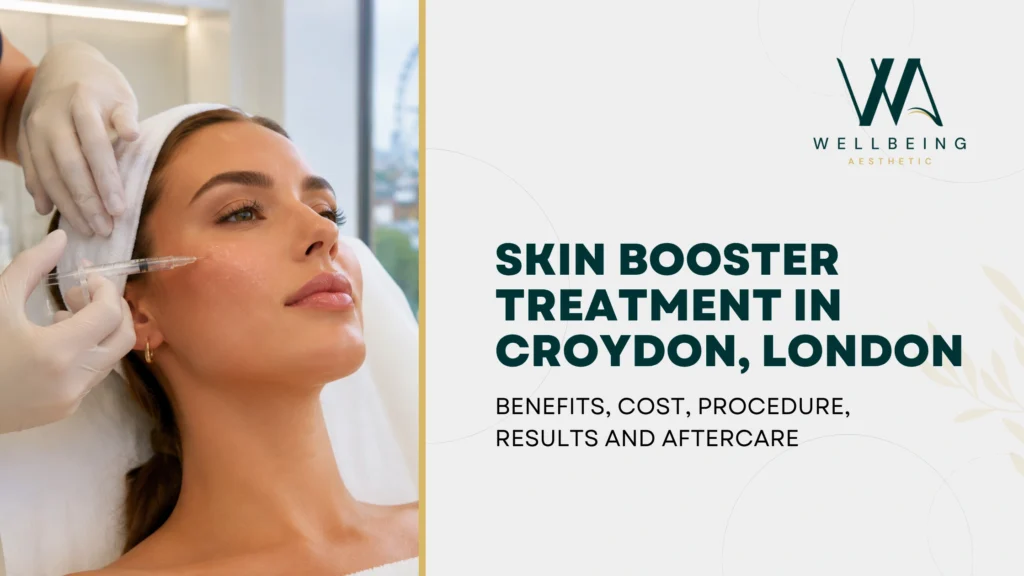
Skin Booster Treatment in Croydon, London: Benefits, Cost, Procedure, Results and Aftercare Dull, tight, dehydrated skin does not usually respond to another serum. You can layer on hyaluronic acid moisturiser every night and still catch your reflection under office lighting and think your skin looks tired rather than tired you feel. That gap between how your skin looks and how well you are taking care of it is exactly the problem skin boosters were designed to close. Skin boosters have become one of the most requested treatments among people in their late twenties, thirties, and forties who are not chasing a dramatically different face, just a healthier looking one. They sit in an unusual space in aesthetic medicine: not a filler, not a wrinkle treatment, but a way of putting hydration back into the skin itself, at a depth no cream can reach. If you are based in Croydon or the wider South London area and searching for what a skin booster treatment actually involves, this guide covers how the treatment works, what it costs, how long results last, and what a sensible aftercare routine looks like. It also looks honestly at when a skin booster is the right call and when a different treatment, such as Profhilo or a dermal filler, might serve you better. None of these replaces a proper consultation. Skin type, medical history, and goals all affect whether skin boosters are the right starting point, which is why every treatment plan at a medically led clinic should begin with an assessment rather than a menu. Key Takeaways Skin boosters treat hydration, not volume. They use micro injections of hyaluronic acid to improve texture and radiance, unlike dermal fillers, which restore lost volume and contour. Results build gradually. Most people notice improved hydration and glow over two to four weeks, not immediately after the appointment. A course works better than a single session. Clinics typically recommend two to three initial sessions spaced several weeks apart, followed by maintenance roughly every four to six months. Downtime is minimal for most people. Mild redness or small bumps at injection points usually settle within a day or two, though bruising is possible. Pricing varies depending on product and location. UK skin booster sessions generally fall between £150 and £450, with London clinics often at the higher end of that range. They are not the same as Profhilo. Skin boosters use lower concentration hyaluronic acid to spread across a wider area, while Profhilo uses a small number of higher concentration injection points to stimulate collagen. Aftercare protects your results. Avoiding makeup, saunas, and strenuous exercise for around 24 hours helps reduce irritation and supports even product distribution. Not everyone is a suitable candidate. Pregnancy, breastfeeding, active skin infections, and certain medical conditions typically mean postponing or avoiding treatment until a practitioner confirms it is appropriate. What Are Skin Boosters? Skin boosters are injectable hyaluronic acid treatments designed to hydrate the skin from within rather than add volume or shape. A practitioner delivers a series of fine micro injections across the treatment area, most often the face, neck, or hands, placing the product just beneath the skin surface where it draws in and holds moisture. Because the formulation is thinner than a typical dermal filler, skin boosters spread evenly through the skin rather than sitting in one spot. That is what makes them suited to overall skin quality rather than to reshaping a specific feature. Many people describe the effect as an injectable version of a deep moisturiser, one that keeps working long after a topical product would have been absorbed and washed away. You can find a summary of skin boosters alongside Wellbeing Aesthetic’s other treatments, including how they compare to Profhilo and dermal fillers on the same page. How Do Skin Boosters Work? Hyaluronic acid occurs naturally in the skin but declines with age, sun exposure, and general wear. Skin boosters replenish that supply directly in the dermis, where the molecule binds to water and gradually plumps into the surrounding tissue. Over several weeks, many patients also see a modest improvement in skin elasticity, since better hydrated skin tends to support its own structure more effectively. What Are the Benefits of Skin Booster Treatment? Skin boosters are most valued for the improvements they bring to skin quality rather than shape. Reported benefits typically include: Noticeably improved hydration and a healthier, less dull complexion Smoother skin texture and a reduction in the appearance of fine, superficial lines A subtle increase in elasticity and firmness as hydration levels improve A more even, radiant look often described as a natural glow rather than an obvious change Suitability for areas that do not need volume, such as under the eyes, the neck, or the backs of the hands These are realistic, gradual outcomes rather than dramatic transformations. Anyone expecting the kind of change associated with dermal fillers is usually better served by a different treatment, or a combination of approach agreed during a consultation. If dehydrated, tired looking skin is your main concern, it’s worth seeing how skin boosters sit alongside Wellbeing Aesthetic’s full range of aesthetic treatments in Croydon before deciding what to book. Skin Boosters vs Dermal Fillers vs Profhilo: What Is the Difference? These three injectable treatments are frequently confused because they all use hyaluronic acid, yet they solve different problems. The table below sets out how they compare. Treatment Main Purpose Typical Results Last Best For Skin Boosters Deep hydration and improved skin texture 4 to 6 months Dull, dehydrated, or tired looking skin without volume loss Dermal Fillers Restoring lost volume and contour 9 to 18 months Hollowed cheeks, thinning lips, or lost facial structure Profhilo Bio remodeling and collagen stimulation 6 to 12 months Overall skin laxity and quality across the face, neck, or hands What Happens During a Skin Booster Treatment in Croydon? A skin booster appointment follows a consistent structure, though the number of injection points and total treatment time depends on the area covered.
ExoSmart Regenerative Therapy: The Complete Treatment Process Explained
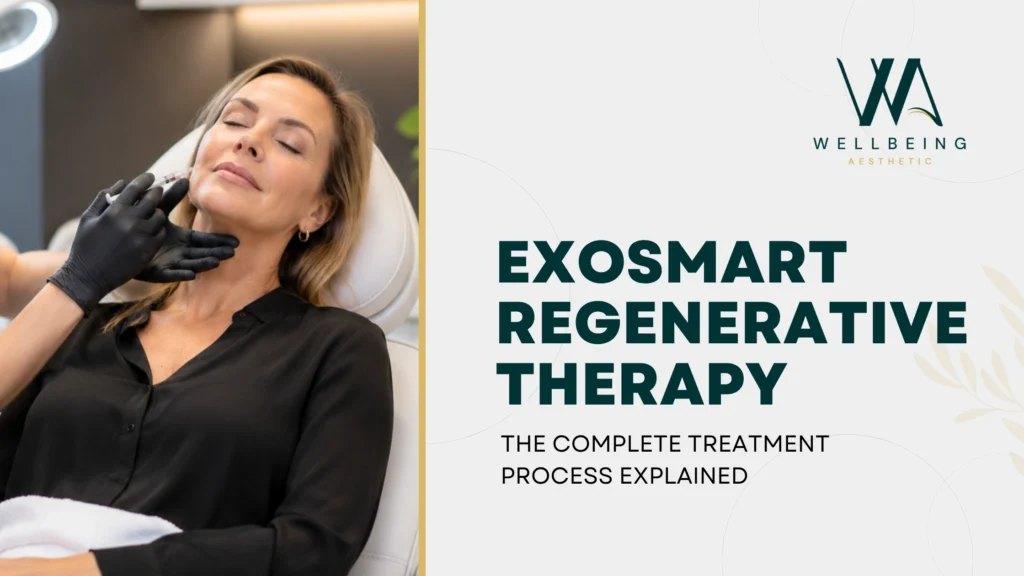
ExoSmart Regenerative Therapy: The Complete Treatment Process Explained If you have been exploring regenerative treatments for skin rejuvenation, hair restoration, or tissue repair, you may have come across ExoSmart – a newer approach that takes the science of PRP one significant step further. Unlike traditional PRP, which concentrates platelets from just one fraction of your blood, ExoSmart processes your entire plasma – capturing a broader range of growth factors, extracellular vesicles, and exosomes that standard PRP leaves behind. The result is a more complete regenerative concentrate, produced from your own blood, processed at point of care, and delivered fresh on the same day. This guide explains exactly how ExoSmart works, what happens during the treatment from first blood draw to final injection, and what makes its technology different from the PRP protocols most clinics currently offer. What Is ExoSmart? ExoSmart is a CE-MDR-certified medical device and processing system designed to produce a concentrated regenerative product from a patient’s own blood. It is used in regenerative medicine and aesthetic treatments including skin rejuvenation, hair restoration, and tissue repair. CE-MDR certification means the device has been independently assessed and approved as a medical device under the EU Medical Device Regulation – one of the most stringent regulatory frameworks in the world for this category of equipment. This is not a cosmetic device; it is a medically regulated system. The key distinction from standard PRP is what ExoSmart concentrates. Rather than isolating platelets from one fraction of the blood, ExoSmart processes the complete plasma – retaining not just platelets but the full plasma secretome: growth factors, extracellular vesicles, and exosomes that sit across both the platelet-rich and platelet-poor fractions of your blood. The treatment is autologous, meaning it uses your own blood with no synthetic additives, foreign substances, or external growth factors introduced into the process. The Science: What Makes ExoSmart Different? To understand why ExoSmart represents a step forward from standard PRP, it helps to understand what standard PRP discards. What standard PRP does A conventional PRP treatment draws blood, spins it in a centrifuge to separate the layers, and collects the platelet-rich plasma (PRP) fraction – the layer that contains a high concentration of platelets and their associated growth factors. The platelet-poor plasma (PPP) – the remaining plasma once the platelets are removed – is typically discarded. That is where the problem lies. A significant proportion of the circulating extracellular vesicles (EVs) and soluble growth factors in your blood – including exosomes – sit in the platelet-poor fraction. Standard PRP removes this fraction and throws it away. What ExoSmart does differently ExoSmart combines both fractions – the PRP and the PPP – and processes them together. The combined plasma (roughly 25 to 30 ml) passes through a precision ultrafiltration cartridge: 870 hollow fibres arranged in a cylinder, with a 15 kDa membrane cutoff. The flow moves tangentially across the fibres – not straight through them. Anything smaller than 15 kDa (primarily water and salt) passes out of the cartridge as filtrate. Everything larger – growth factors, extracellular vesicles including exosomes, platelets, fibrin, and plasma proteins – stays in the retentate. What comes out is approximately 6 to 7 ml of concentrated autologous secretome: the complete active biology of your plasma, not just the platelet fraction. The tangential flow serves a second purpose beyond concentration. The mechanical shear it generates activates a substantial portion of the platelets through a process called mechanotransduction – without the need for calcium chloride, thrombin, or any chemical activation agent. This means you get immediate soluble-cargo release from activated platelets, plus an intact platelet fraction that continues releasing after injection. In short: ExoSmart delivers the complete secretome – the vesicles, the growth factors, and the activated platelets – in one 6 to 7 ml dose, from your own blood, ready to inject. The ExoSmart Treatment Process: Step by Step One of the practical advantages of ExoSmart is how cleanly it fits into a standard clinic appointment. The full workflow – from blood draw to injection – runs between 20 and 30 minutes. Here is what happens at each stage. Step 1 – Consultation and Assessment Before any blood is drawn, your practitioner conducts a thorough consultation. This covers your medical history, any medications you are taking (particularly NSAIDs or blood thinners), your treatment goals, and an assessment of the target area – whether that is your skin, scalp, or another site. At Wellbeing Aesthetic, no treatment begins without this assessment. Understanding your health and your goals is not a formality; it determines whether ExoSmart is the right choice for you, and if so, exactly how it should be delivered. Step 2 – Blood Draw Approximately 60 ml of blood is drawn from your arm using a standard venepuncture technique, collected into tubes containing ACD (Acid Citrate Dextrose) – an anticoagulant solution that prevents clotting during processing. To put this in context: 60 ml represents roughly 1.2 percent of your total blood volume. This is comparable to a standard blood test and well within the range your body handles without any physiological effect. Most patients report minimal discomfort at this stage – no different from routine bloodwork. Step 3 – Centrifugation The collected blood is placed in a centrifuge – any validated PRP centrifuge already used in the clinic will work; ExoSmart is not tied to proprietary spinning hardware. The spin separates the blood into its component layers and isolates the plasma. The key difference from standard PRP at this stage: rather than selecting only the platelet-rich fraction, ExoSmart uses both the PRP and the PPP. Both fractions are combined, giving approximately 25 to 30 ml of whole plasma to process. Step 4 – Ultrafiltration This is the step that makes ExoSmart distinct from every standard PRP protocol. The combined plasma goes into the ExoSmart device – a compact unit approximately the size of a large syringe barrel, held in the hand. There is no pump, no power source, no cold chain required. The practitioner pushes the